What to expect on a whale watching tour
Most tours from Campbell River leave from marinas along the downtown waterfront. Eagle Eye Adventures departs from Coast Marina on Island Highway, and its booking listings ask guests to arrive about 30 minutes early for check-in and a safety briefing.
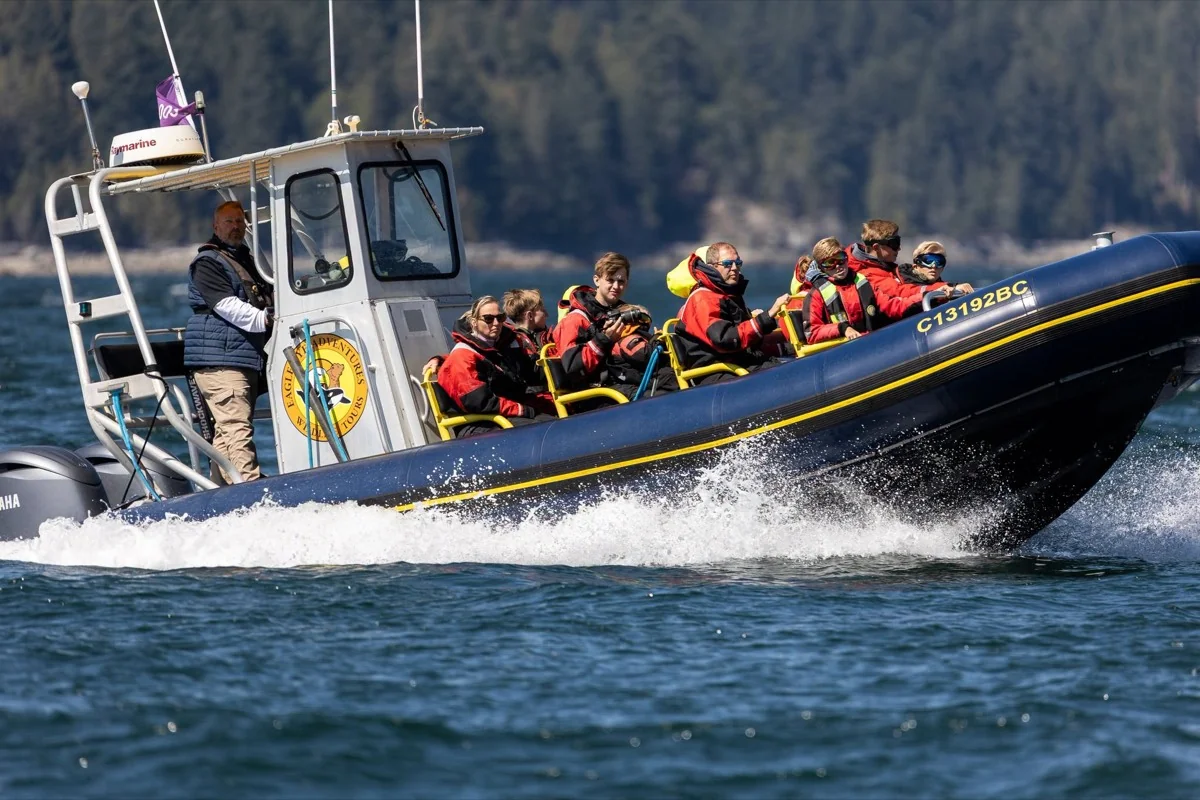
- Check in and suit up. Zodiac guests are fitted with full-body flotation suits; covered-boat guests board a heated or sheltered cabin.
- Head into the channels. Routes depend on tides, weather and recent sightings, often covering Discovery Passage, the Discovery Islands and fast-water areas such as Seymour Narrows.
- Search with a naturalist. Guides scan for blows, birds working bait balls and reports from other boats, and explain behaviour, ecology and local history as you go. Some boats carry a hydrophone to listen underwater.
- Watch at a respectful distance. When wildlife is found, the skipper slows, positions the boat within the legal approach distances and lets the animals set the pace.
Zodiac or covered boat?
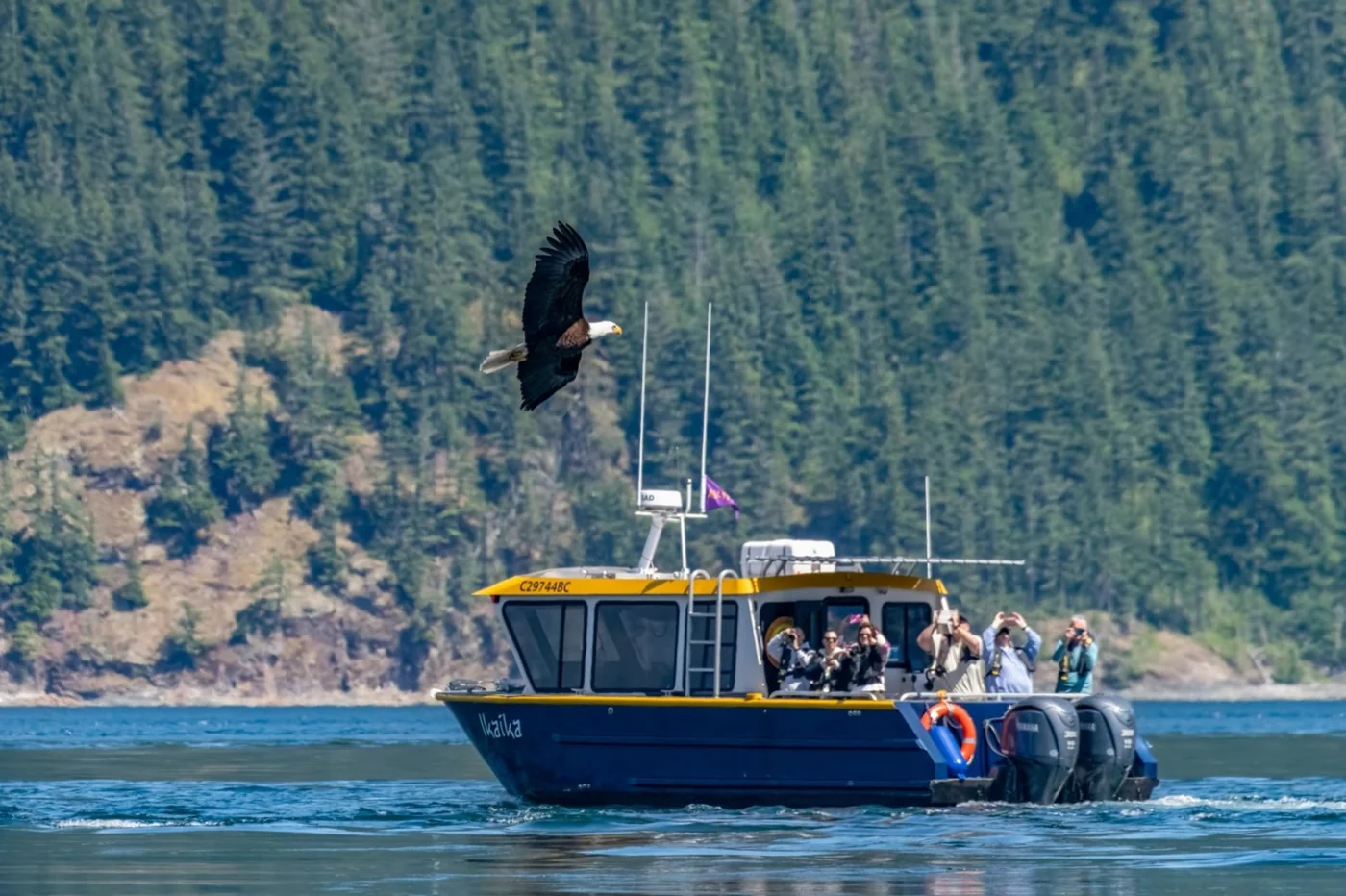
Both featured tours offer either option, and both follow the same viewing rules. The right choice comes down to how you like to travel.
What to wear and bring
Even on warm summer days, the wind on open water can feel far cooler than on shore. Dress in layers you can add and remove.
- Thermal base layer and fleece or wool mid-layer
- Waterproof, windproof outer shell
- Warm hat, gloves and closed-toe shoes
- Sunglasses with a strap and sunscreen
- Binoculars and a camera with zoom
- Water bottle and any seasickness remedy you use
Listings for Eagle Eye’s covered boat mention gloves, hats and survival suits supplied on board. Confirm what’s included for your tour when you book.
Responsible whale watching: the viewing rules
Canada’s Marine Mammal Regulations, made under the Fisheries Act, prohibit disturbing marine mammals and set minimum approach distances for all vessels, from tour boats to kayaks and paddleboards. Here is how they apply in BC’s Pacific waters as of the 2026 season.
100 m
Minimum for most whales, dolphins and porpoises. Allow 200 m if they are resting or with a calf.
200 m
Minimum distance from killer whales in BC and the Pacific Ocean
1,000 m
From Southern Resident killer whales in designated southern BC waters, June 1, 2026 to May 31, 2027
The 1,000-metre measure for endangered Southern Resident killer whales is set by a Transport Canada interim order while Fisheries and Oceans Canada finalizes amendments to the regulations. Distances for other killer whales, including the Bigg’s and Northern Resident orcas most often seen near Campbell River, remain 200 metres. These measures are reviewed every year, so treat this as a summary and check the official sources for current rules.
Good practice on the water
- Slow down and reduce noise near wildlife
- Never position a boat in a whale’s path or between animals
- Avoid encircling or chasing; let animals choose the distance
- Never feed or touch marine mammals
Official guidance: Fisheries and Oceans Canada · Transport Canada
Getting to Campbell River
Campbell River is on the east coast of central Vancouver Island, at the point where the Strait of Georgia narrows into Discovery Passage. Most visitors arrive one of three ways.
By road
Drive north on Highway 19 from Nanaimo, where BC Ferries arrive from the mainland. Allow a couple of hours.
By air
Campbell River Airport (YBL) is just south of the city, with scheduled service from Vancouver. Check current routes before booking.
By water
Campbell River is the departure point for the 10-minute ferry to Quadra Island, with a connection on to Cortes Island.
Planning tips
- Book ahead in July and August. Small boats fill quickly in high season.
- Leave a buffer day. Wind and fog can move departures; a flexible schedule gives you a second chance.
- Match the tour to your goal. Choose six hours if whales are the priority, four if you want a broad wildlife introduction.
- Think about season. See our best time to see whales guide for a month-by-month view.
Ready to choose a tour?
Compare the 6-hour and 4-hour Eagle Eye Adventures experiences side by side.